- 3min read
- |
Indian Protein-Rich Foods for Vegetarians: A Complete, Practical Nutrition Guide
Summary:
If you’ve grown up in an Indian household, chances are your meals already include dal, curd, roti, rice, paneer, or nuts. Yet, one question keeps coming up i
“Am I getting enough protein as a vegetarian?”
The short answer: Yes, you can - very comfortably,if your diet is planned wisely.
India has a rich vegetarian food culture that naturally supports protein intake. The problem is not vegetarian food—it’s lack of awareness and variety. Let’s break this down in a simple, practical way

By Shailja Dubey
Nutritionist and Science Communication Lead– Prolicious

Table of Contents
- Do Indian Vegetarians Get Enough Protein?
- Why Protein Is Important for Daily Health
- How Much Protein Do You Need?
- Complete vs Incomplete Proteins (Made Simple)
- Protein-Rich Indian Vegetarian Foods
- Traditional Indian Meals That Complete Protein
- High-Protein Vegetarian Meal Ideas
- Common Myths About Vegetarian Protein
- Summary
-
Frequently Asked Questions
Why Protein Matters (And It’s Not Just for Muscles)
Protein is often associated only with bodybuilders, but in reality, it is essential for everyone.
Protein helps with:
- Muscle repair and strength (important even if you don’t exercise)
- Immunity (antibodies are made of protein)
- Hormones and enzymes
- Energy levels and satiety (you feel full for longer)

According to the Indian Council of Medical Research (ICMR) and WHO, adults need about:
- 0.8 gram of protein per kg body weight per day
- So, a 60 kg adult needs roughly 48g protein daily.
References:
- ICMR Dietary Guidelines: https://www.nin.res.in
- WHO Protein Requirements: https://www.who.int/publications
Why Vegetarians Need Variety (Not Supplements)
Proteins are made of smaller units called amino acids.
Out of these, 9 are “essential”, meaning our body cannot make them and that is why we must get them from food.
Complete vs Incomplete Proteins (In Simple Terms)
-
Complete proteins contain all 9 essential amino acids
Examples: Milk, curd, paneer, soy, tofu -
Incomplete proteins lack one or more amino acids
Examples: Dal, cereals, nuts
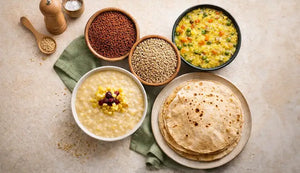
Indian meals naturally combine foods in a way that completes the protein.
This concept is called complementary proteins, and our traditional diets have followed it for centuries.

Protein-Rich Dal Varieties (Every Indian Kitchen Staple)
Dal is affordable, accessible, and highly nutritious.
|
Dal Type |
Protein (per 100g raw) |
|
Moong dal |
~24 g |
|
Masoor dal |
~22 g |
|
Toor dal |
~21 g |
|
Urad dal |
~22 g |
|
Chana dal |
~21 g |
Dairy: A Powerful Protein Source for Vegetarians
Dairy provides high-quality protein along with calcium.
- Paneer: ~18 g protein per 100 g
- Curd / Greek yogurt: 8–10 g per cup
- Milk: 6–7 g per cup
Paneer contains casein protein, which digests slowly and keeps you full longer.
Plant-Based Complete Protein Foods (Worth Including)
Some plant foods naturally provide complete protein:
- Soy chunks – ~52 g protein per 100 g
- Tofu – ~10–12 g per 100 g
These are now easily available in Indian markets and online stores.
Practical idea:
Add soy chunks to pulao, upma, or sabzi
Seeds, Nuts & Everyday Superfoods
Small quantities, big impact.
- Peanuts, almonds: 6–8 g per handful
- Pumpkin seeds, flaxseeds, chia seeds
- Makhana (fox nuts): light, protein-rich snack

Nutritionist tip:
Dry roast seeds and store in airtight containers. Sprinkle on:
- Curd
- Dal
- Poha
- Salads
Traditional Indian Meals That Naturally Complete Protein
This is where Indian food truly shines.
|
Meal |
Why It Works |
|
Dal + rice |
Cereal + legume = complete protein |
|
Rajma + chawal |
Perfect amino acid balance |
|
Idli + sambar |
Rice + lentils |
|
Chole + roti |
Wheat + chickpeas |
High-Protein Vegetarian Meal Ideas
Breakfast
- Moong dal chilla + curd
- Paneer bhurji + toast
- Besan cheela with vegetables
Lunch / Dinner
- Rajma masala + rice
- Palak paneer + roti
- Soya chunk pulao

Common Myths About Vegetarian Protein (Let’s Clear Them)
- Myth -“Vegetarians can’t build muscle”
- Fact -Indian vegetarian athletes and bodybuilders prove otherwise
- Myth - “Protein supplements are necessary”
- Fact -Food-first approach works for most people
- Myth -“Dal alone is enough to manage protein deficiency”
- Fact -Only dal is not enough, we need a variety of sources.
Summary
- Indian vegetarian diets can easily meet protein needs when planned properly.The key is variety, not just increasing quantity
- .Combining foods (dal + rice, roti + paneer) ensures complete protein intake.
- Dairy and soy are high-quality protein sources for vegetarians.
- Nuts, seeds, and dals add additional protein and micronutrients.
- Most individuals do not require protein supplements if their diet is balanced.
Frequently Asked Questions
-
How much protein do vegetarians need daily in India?
~0.8g per kg body weight -
Can Indian vegetarian foods provide complete protein?
~Yes, through combinations like dal-rice, roti-paneer -
Is paneer a good protein source?
~Yes, especially for vegetarians -
Can you build muscle on a vegetarian diet?
~Absolutely, with proper planning -
Are supplements necessary?
~Only if food intake is inadequate or during medical needs